


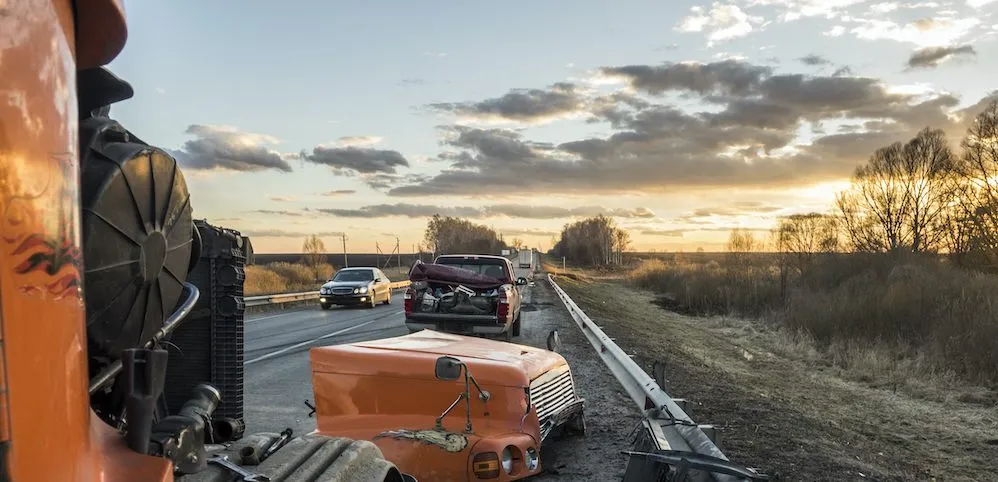
You are merging onto I-85 at the interchange with I-77 just north of Uptown Charlotte, the one where the northbound and southbound lanes briefly cross, when a loaded tractor-trailer cuts across three lanes to catch its exit before missing it entirely. There is no room left in your lane by the time you see the trailer coming, and the impact slams your car into the barrier. The sound of the crash keeps replaying in your head. You can’t get out of your car, you’re not really sure what happened, and you don’t know what to do now. When you need a Charlotte truck accident attorney, Mehta & McConnell, PLLC, is here to walk with you through the steps that come next.
You can reach our lawyers at 980-326-2270.

Key Takeaways
- After a truck accident, call 911, seek medical attention, preserve evidence, exchange information, and avoid admitting fault.
- Truck accident claims are more complex than car accident cases, often involving federal regulations, multiple liable parties, and commercial trucking companies.
- You may recover compensation for medical expenses, lost wages, property damage, pain and suffering, and, in some cases, punitive damages.
- An experienced Charlotte truck accident lawyer can preserve critical evidence, prove negligence, defend against contributory negligence claims, and pursue the maximum compensation available.
What Can a Charlotte, NC Truck Accident Lawyer Do for You?
Truck crashes are some of the most damaging and traumatic collisions that happen on the road. Recovering physically, financially, and emotionally can be a daunting task for injury victims.
An experienced truck accident attorney can step in and provide valuable legal guidance and support in the wake of a crash. At Mehta & McConnell, we investigate the crash, identify every party who may share responsibility, and deal directly with insurance adjusters so you don’t have to. Trucking companies send their own investigators to serious crash sites within hours, and having someone in your corner levels that playing field from the start.
Who Can Be Held Responsible for a Truck Accident?
A crash involving a commercial truck raises different questions than a collision between two passenger vehicles. A truck moving through the I-85, I-77, and I-485 corridors may have picked up or transferred freight through a facility such as the CSX intermodal terminal, passed an NCDOT weigh station along I-85 or I-77, or carried a load arranged by companies far outside Charlotte. That can leave a Charlotte truck accident attorney investigating not only the driver, but also:
- The truck driver—speeding, distraction, fatigue, impairment, or another unsafe driving decision may have caused the collision;
- The motor carrier—the trucking company may bear responsibility for its driver’s conduct or for unsafe hiring, training, supervision, scheduling, maintenance, or safety practices;
- The cargo operation—a shipper or loading company may have improperly loaded or secured freight, increasing the risk of a rollover, jackknife, or lost load;
- The truck or component manufacturer—defective brakes, tires, steering systems, underride equipment, or other parts may contribute to a serious collision; and
- Other companies involved in the shipment—depending on the facts and applicable federal law, the investigation may also examine entities that arranged or controlled the transportation.
Sorting out those roles early matters because each company may hold different evidence, insurance coverage, and legal responsibility. Identifying those connections can keep a potentially liable party from disappearing into the paperwork.
Why Does a Charlotte Truck Accident Attorney Handle Truck Accidents Differently from Car Accident Cases?
A commercial truck crash can involve evidence, safety rules, and insurance issues that usually do not exist in a routine two-car collision. A Charlotte truck accident attorney may need to account for:
- Federal trucking regulations—FMCSA rules govern driver hours, electronic logging, vehicle maintenance, cargo securement, and other safety requirements;
- Commercial records—ELD data, dispatch messages, maintenance files, inspection reports, and driver qualification records can help explain what happened before the crash;
- Evidence controlled by the trucking company—important records may remain with the carrier or its vendors, which makes early preservation especially important;
- Specialized crash analysis—serious collisions may require accident reconstruction experts to interpret vehicle damage, electronic data, roadway evidence, and police findings; and
- Commercial insurance defenses—trucking insurers may begin investigating quickly and look for evidence that reduces the carrier’s exposure, including arguments that the injured person contributed to the crash.
Those extra layers can make the investigation more technical and more time-sensitive than a typical passenger-vehicle claim.
| Potentially Liable Party | Why They May Be Responsible |
|---|---|
| Truck Driver | The driver may be liable for speeding, fatigue, distraction, or other unsafe conduct behind the wheel. |
| Trucking Company | The company that employs the driver may be liable for poor hiring practices, inadequate training, or pressuring drivers to violate hours-of-service rules. |
| Broker | The broker who arranged the shipment can share liability for their choice of carrier, especially if that carrier had a history of safety violations the broker should have caught. |
| Cargo Loading Company | Improperly loaded or secured cargo can shift or fall, contributing to rollovers, jackknifes, or debris-related crashes. |
| Truck Parts Manufacturer | A defective part, such as brakes, tires, or underride guards, can make the manufacturer liable if a mechanical failure caused or worsened the crash. |
Charlotte Truck Accident Statute of Limitations Calculator
Enter the date of your accident to see the filing deadline that generally applies to your situation under North Carolina law.
What Types of Injuries Do Truck Accident Lawyers Often See?
Truck accident lawyers often represent people dealing with injuries such as:
- Spinal cord injuries,
- Traumatic brain injuries,
- Severe burns,
- Crush injuries and fractures, and
- Neck and back injuries.
Serious injuries often require more than emergency treatment, which is why a truck accident claim may need to account for future medical care, rehabilitation, and lost earning capacity, as well as the losses you are facing now.
What Compensation Can You Pursue After a Truck Accident?
North Carolina law allows injured people to pursue compensation for both economic costs, which are the costs you can add up on paper, and noneconomic costs, which are the harder-to-measure ways an injury has changed their life. For someone taken from a serious truck crash to Atrium Health Carolinas Medical Center, the region’s only Level I Trauma Center, those losses can begin with intensive emergency care and continue long after discharge.
Injury victims often recover compensation for:
- Medical costs—emergency treatment, surgery, physical therapy, and any future care your injuries require;
- Lost income and earning capacity—wages you have already missed, plus compensation if your injuries keep you from returning to the same job, or any job;
- Pain and suffering—physical pain and emotional distress connected to your injuries;
- Loss of enjoyment of life—the hobbies, relationships, and daily activities your injuries have taken from you; and
- Wrongful death damages—if a truck accident causes the death of a loved one.
The severity of a truck accident often means these losses stack up quickly, and a fair recovery accounts for all of them, including the ones that aren’t on a bill yet. If you were working when the crash happened, you may also have a workers’ compensation claim before the NC Industrial Commission alongside a claim against the third party that caused the collision.
How Do FMCSA Rules Affect a Charlotte Truck Accident Claim?
An investigation may examine whether the trucking company or driver complied with FMCSA rules involving:
- Hours of service,
- Electronic logging,
- Vehicle inspection and maintenance,
- Driver qualifications,
- Cargo securement, and
- Safety management.
FMCSA’s North Carolina Division, which falls under the agency’s Southern Service Center, oversees motor carrier safety compliance in the state, while the North Carolina State Highway Patrol’s Motor Carrier Enforcement program conducts roadside inspections and other commercial vehicle enforcement. The NC Governor’s Highway Safety Program also supports commercial motor vehicle safety efforts across the state. For an injured person, that enforcement history can matter if inspection reports, out-of-service orders, or prior safety violations show that the truck or carrier had problems before the crash.
The Insurance Industry Doesn’t Want You to Know About North Carolina’s Fault Rule
North Carolina is one of only a handful of states left in the country that follows what is called a pure contributory negligence rule. Under this rule, if you are found even one percent at fault for the crash, you can be barred from recovering anything at all, even if the truck driver was 99% responsible.
Unfortunately, this can give insurance companies an easier justification for denying you compensation after an accident. In many cases, insurers will push to find that one percent of fault on your end, even if it was just a single glance at your phone, and try to prove it in court.
The pure contributory negligence rule can add serious complications to the process of getting just compensation after a truck accident injury. It also makes having qualified legal support all the more critical for injury victims. A skilled attorney can gather evidence to challenge unfair fault attributions and advocate for you to recover the full amount of damages you’re legally entitled to.
What Tactics Does a Trucking Company’s Insurer Use After a Charlotte Truck Crash?
A trucking insurer’s job is to investigate the claim, evaluate the company’s exposure, and limit what the insurer ultimately pays. After a Charlotte truck crash, an adjuster may:
- Request a recorded statement. The insurer may ask detailed questions about the crash before you have reviewed the police report or had time to understand exactly what happened.
- Seek broad medical information. An authorization can give the insurer access to records it may use to argue that some symptoms existed before the collision.
- Look for contributory negligence. Because North Carolina can bar recovery if the injured person contributed to the crash, insurers have a powerful incentive to search for evidence they can characterize as fault.
- Minimize future medical needs. An early evaluation may not account for surgery, rehabilitation, complications, or permanent restrictions that appear later.
- Question lost-income claims. The insurer may dispute whether the crash caused missed work, reduced hours, or diminished earning capacity.
- Offer an early settlement. A quick payment can become far less attractive once the full extent of an injury becomes known.
At Mehta & McConnell, we began our careers representing corporations and insurance companies. We understand how insurers investigate serious claims, evaluate exposure, develop defenses, and look for ways to reduce what they pay. We use that insurance defense background on the other side of the table, helping injured people recognize the strategy coming at them before it shapes their case.
Why You Need a Charlotte, NC Truck Accident Lawyer Before the Deadline Passes
North Carolina law generally gives injured people three years from the date of the crash to file a personal injury lawsuit. Waiting creates real risk. Trucking companies are not required to retain black box data, dashcam footage, or driver logs indefinitely, and some records are erased or overwritten within weeks of a crash. Getting a legal team investigating early means that evidence gets locked down before it disappears.
Why Choose Mehta & McConnell as Your Charlotte, NC Truck Accident Attorney
Our attorneys started their careers defending large corporations and insurance companies, and we now put that same insider knowledge to work exclusively for injured people. That includes a $2,750,000 settlement for a delivery driver who suffered incomplete quadriplegia when a load of metal doors fell on him, and a $690,000 recovery for the family of a rideshare passenger killed by a drunk driver. As the official personal injury law firm partner of the Charlotte Checkers, we stay rooted in the community we represent, and we speak Spanish, so language is never a barrier between a client and the answers they need.
Your Next Step Costs You Nothing. Waiting Might.
A truck accident can upend your finances, your health, and your sense of what comes next, and you shouldn’t have to sort through any of it with an insurance company’s interests in mind instead of your own. Mehta & McConnell will look at what happened, explain what your options actually are, and stand with you at every step toward the recovery you deserve. Reach out today for a free, no-commitment consultation to find out where you stand.
Legal References Used to Inform This Page:
To ensure the accuracy and clarity of this page, we referenced official legal and other resources during the content development process:
- Personal Injury Statute of Limitations, N.C. Gen. Stat. § 1-52(16).
- Full Guide to Wrongful Death Claims and Accidents
Meet Our Charlotte, NC Truck Accident Lawyer

Attorney Viral Mehta is the co-founder of Mehta & McConnell PLLC and an experienced rideshare accident attorney who represents individuals injured in rideshare, car, and other motor vehicle accidents throughout North Carolina. A Charlotte native, Mr. Mehta brings valuable insight from his early career defending insurance companies, allowing him to anticipate insurers’ strategies and advocate effectively for injured clients. A North Carolina State Bar Board-Certified Specialist in Workers’ Compensation Law and a North Carolina Super Lawyer, he is dedicated to helping accident victims pursue the compensation they deserve with skilled, personalized legal representation.
Why Charlotte Truck Accident Victims Choose Mehta & McConnell
- Detailed Knowledge of Trucking Regulations and Insurer Tactics: Our attorneys know federal hours-of-service rules, load requirements, and maintenance standards inside and out, and they know how trucking company insurers respond to claims in the Charlotte area.
- Former Defense Counsel Now Advocating for Injured Victims: Both Viral Mehta and Jason McConnell defended employers and insurers before co-founding Mehta & McConnell. They use that experience to anticipate and counter the other side’s arguments in truck accident cases.
- Handling Complex Multi-Party Claims: Truck accident cases often involve multiple defendants including drivers, trucking companies, and cargo handlers. We identify all liable parties and pursue maximum compensation from each applicable source.
- Board-Certified and Recognized Across North Carolina: Our attorneys are NC State Bar-certified specialists recognized by Super Lawyers, with a history of successful outcomes for seriously injured clients throughout the Charlotte metro area.
- Free Consultation, Contingency Fee Basis: There is no charge for your initial case review. You pay nothing in attorney fees unless we recover money on your behalf.
Where Most Truck Accidents Happen in Charlotte, NC
Charlotte’s busiest interstate interchanges carry heavy commercial truck traffic alongside daily commuters, and tight ramp curves combined with high freight volume have produced a documented pattern of serious tractor-trailer crashes.
I-85 / I-77 Interchange, North Charlotte
This interchange is particularly notorious for truck crashes due to tight ramp curves and heavy truck volume, including repeated tractor-trailer rollovers on the connecting ramps.
I-85 Near Sam Wilson Road
A fatal tractor-trailer crash has been documented along this stretch of west Charlotte interstate.
I-85 at Tuckaseegee Road
The site of a tractor-trailer crash into the median near bridge supports.
I-85 Near Statesville Road, North Charlotte
A multi-car crash involving a tractor-trailer has been documented at this location.
I-85 Near Charlotte Douglas Airport
An NHTSA data analysis identified this roughly 10-mile stretch as the deadliest highway segment in North Carolina, and it carries heavy freight volume alongside commuter traffic.
I-485 Outer & Inner Loop Interchanges
This beltway carries heavy commercial traffic, and a segment near the airport ranks among the state’s deadliest highway stretches.
I-77 Near Uptown (Brookshire Freeway/I-277)
Truck fires and crashes have been documented on this stretch of interstate near the city center.
S. Tryon Street at Westinghouse Boulevard
This intersection in the Steele Creek industrial and logistics area has a documented history of serious crashes.
Hit by a Truck? Insurance Companies Won’t Make It Easy. We Will.
Speak to a Charlotte Truck Accident LawyerThe Client Experience
What It Is Like to Work With Mehta & McConnell
A serious truck accident case can take years. Here is what working with our Charlotte team looks like, in the words of the people who have lived it.
We take on the cases that are hard to win
Complex truck and injury cases are often turned away because the proof is hard to build. That is the work we choose to do.
“He was very knowledgeable in every aspect. Yes, we have rough patches, but the amount I won was perfect.”
Vaughn J., Google Review
We keep you informed in plain language
You will always understand what is happening and what comes next, without the jargon and without chasing us for an update.
“Attorney Mehta and his staff were very professional, informative, and caring throughout the process.”
Rosalyn A., Google Review
We carry the weight so you can heal
We handle the insurers, the medical providers, and the paperwork, so you can focus on your recovery and your family.
“Excellent service from the lawyer. He helped my wife, who is very happy with the results we achieved.”
Gabriel C., Google Review
A truck accident can upend everything. We cannot undo it, but we can carry the weight of everything that comes after, and stay beside you until you are able to rebuild.
What You Need to Know About North Carolina Workers’ Compensation Laws
Get Your Free Case Evaluation Now!
Types of Truck Accidents We Handle in Charlotte
Not every trucking accident happens the same way, and the type of truck and the cause of the crash often shape who is liable and how a claim should be built. Our attorneys regularly handle the following types of cases for Charlotte-area clients.
- Commercial Truck Accidents: Semi-trucks, box trucks, and other commercial vehicles operate under federal trucking regulations that don’t apply to ordinary passenger cars, which often changes how liability is determined.
- Garbage Truck Accidents: Frequent stops, large blind spots, and residential routes make garbage truck collisions especially common in neighborhoods, often involving pedestrians, cyclists, or parked vehicles.
- Tanker Truck Accidents: Tankers carrying liquid or hazardous cargo face a higher risk of rollover from cargo surge, and a spill or leak can create additional environmental and safety hazards.
- Truck Driver Fatigue Accidents: Federal hours-of-service rules exist because drowsy driving is a leading cause of serious trucking accidents, and violations can be a key piece of evidence in a claim.
- Underride Accidents: When a passenger vehicle slides underneath a trailer, the results are often catastrophic, and questions about the trailer’s underride guards can become central to the case.
- Truck Rollover Accidents: A high center of gravity, sharp curves, and improperly secured cargo all raise the risk of a truck rolling over, often affecting multiple vehicles nearby.
- Truck Tire Blowout Accidents: Poor maintenance or tread separation can cause a sudden blowout, leading the driver to lose control, especially at highway speeds.
- Jackknife Truck Accidents: When a trailer swings out at an angle to the cab, often during sudden braking or on a wet road, it can block multiple lanes and cause a multi-vehicle collision.
Frequently Asked Questions:
What happens if I was partly at fault for the truck accident?
Under North Carolina’s pure contributory negligence rule, even being found 1% at fault can bar you from recovering any compensation, no matter how much more at fault the truck driver was. Insurance companies often look hard for any small share of blame they can pin on you for this reason. An attorney can help gather evidence to push back on unfair fault claims and protect your right to recover.
How long do I have to file a truck accident claim in North Carolina?
You generally have three years from the date of the crash to file a personal injury lawsuit in North Carolina. Waiting can hurt your case since trucking companies aren’t required to keep black box data, dashcam footage, or driver logs indefinitely, and some of that evidence can be erased within weeks.
Who can be held responsible for a truck accident?
Liability can extend beyond the truck driver to the trucking company, the broker who arranged the shipment, the cargo loading company, or the truck parts manufacturer. For example, a broker’s decision to hire a carrier with a history of safety violations can be just as important to a case as who was actually driving.
Can I Sue the Trucking Company, Not Just the Driver, After a Crash in Charlotte?
Yes, depending on what caused the crash. A trucking company may be liable for its driver’s conduct or for problems involving hiring, supervision, maintenance, scheduling, or safety practices. Other companies involved with the truck or cargo may also share responsibility.
What Is a Truck’s Black Box, and How Does It Help My Charlotte Accident Case?
A truck’s “black box” can store electronic data about how the vehicle operated before a crash, including speed, braking, engine activity, and other vehicle functions. A Charlotte truck accident lawyer may also seek Electronic Logging Device (ELD) records, which can show when the driver was driving, working, or resting.
FMCSA requires motor carriers to retain ELD records of duty status and supporting documents for six months, so some of the most useful evidence can disappear long before North Carolina’s three-year filing deadline expires. Preserving that evidence early also gives the Charlotte-Mecklenburg Police Department’s Major Crash Investigation Unit and accident reconstruction experts more to work with when they compare electronic truck data, vehicle damage, and scene evidence to determine how the collision happened.
How Do Federal FMCSA Regulations Affect My Truck Accident Injury Claim in North Carolina?
FMCSA rules regulate driver hours, vehicle maintenance, driver qualifications, cargo securement, and other safety issues. A violation connected to the crash can provide important evidence about why it happened and who may be responsible.
What Should I Do If the Trucking Company’s Insurance Adjuster Contacts Me After the Crash?
Be cautious about giving a recorded statement, signing broad medical authorizations, or accepting an early settlement. You can direct the adjuster to your Charlotte truck accident lawyer, who can handle those communications for you.
How Long Do I Have to File a Truck Accident Lawsuit in North Carolina, and Why Does Timing Matter?
North Carolina generally gives you three years to file a personal injury lawsuit. But evidence such as ELD records and other electronic data can disappear much sooner, so contacting an attorney early can help preserve it.
Can multiple parties be held liable in a Charlotte truck accident, not just the driver?
Yes, often. Depending on what caused the crash, liability can extend to the trucking company for negligent hiring or maintenance, a cargo loading company if improperly secured freight caused the crash, or even a parts manufacturer if a mechanical failure was involved.
Does a truck accident claim have a different filing deadline than a regular car accident claim in North Carolina?
No. The same three-year statute of limitations for personal injury claims generally applies to truck accidents as to standard car accidents in North Carolina, though truck accident cases often involve more parties and evidence, making early legal involvement especially valuable.
Can a truck driver’s logbook be used as evidence in a Charlotte truck accident case?
Yes, often significantly. Federal law requires truck drivers to maintain hours-of-service logs, and discrepancies or violations in these logs, such as evidence of driving beyond legal limits, can serve as strong evidence of negligence in a truck accident claim.
Local Resources in Charlotte, NC
If you’ve been injured in Charlotte, these trusted local resources can assist you with emergency care, reporting, transportation, and vehicle repairs. While these services can help in the immediate aftermath, speaking with a lawyer as soon as possible can help protect your rights and your claim.
Police & Public Safety
Charlotte-Mecklenburg Police Department (CMPD)
601 E. Trade St., Charlotte, NC 28202. Handles local law enforcement, traffic accident investigations, and police reports within Charlotte city limits. Call (704) 336-7600 for non-emergency assistance or records requests.
Visit WebsiteNorth Carolina State Highway Patrol – Troop H Headquarters
12101 Mt. Holly-Huntersville Rd., Huntersville, NC 28078. Responds to crashes on Interstate 77, Interstate 85, Interstate 485, and other state highways throughout Mecklenburg County. Call +1 704-331-3300 for highway accident assistance and report inquiries.
Visit WebsiteMecklenburg County Sheriff’s Office
700 E. 4th St., Charlotte, NC 28202. Provides law enforcement services for county facilities, court security, and detention operations. For certain county-related records and assistance, call (704) 336-8100.
Visit WebsiteAccident Reports & Records
Charlotte-Mecklenburg Police Department (CMPD)
601 E. Trade St., Charlotte, NC 28202. Handles local law enforcement, traffic accident investigations, and police reports within Charlotte city limits. Call (704) 336-7600 for non-emergency assistance or records requests.
Visit WebsiteNorth Carolina Division of Motor Vehicles (DMV) Crash Reports
Request official crash reports for reportable traffic accidents investigated by law enforcement agencies across North Carolina.
Request ReportNorth Carolina State Highway Patrol Collision Information
Request crash reports for accidents investigated by the North Carolina State Highway Patrol on state highways and interstates.
Request ReportMedical & Emergency Care
Atrium Health Carolinas Medical Center
1000 Blythe Blvd, Charlotte, NC 28203, United States. Level I Trauma Center providing 24/7 emergency care, trauma surgery, advanced imaging, and specialized treatment for serious accident injuries. Call 704-355-2000.
Visit WebsiteNovant Health Presbyterian Medical Center
200 Hawthorne Ln., Charlotte, NC 28204. Offers emergency medical services, trauma stabilization, surgery, diagnostic imaging, and comprehensive inpatient care. Call (704) 384-4000.
Visit WebsiteAtrium Health University City
8800 N. Tryon St., Charlotte, NC 28262. Provides emergency treatment, diagnostic imaging, orthopedic care, and inpatient services for accident victims. Call (704) 863-6000.
Visit WebsiteTowing & Roadside Assistance
Queen City Towing
Provides 24/7 emergency towing, roadside assistance, accident recovery, and vehicle transport services throughout Charlotte and surrounding communities. Call (704) 332-0001.
Visit WebsiteCollision Repair & Auto Body Shops
Caliber Collision – Charlotte
10421 S Tryon St, Charlotte, NC 28273, United States. Trusted collision repair provider offering insurance coordination, dent repair, painting, and lifetime warranties on repairs. Call 704-496-7700.
Visit WebsiteHendrick Collision Center South – Charlotte
8901 South Blvd, Charlotte, NC 28273, United States. Full-service collision repair and auto body shop specializing in post-accident vehicle restoration and auto glass replacement. Call (704) 527-4900.
Visit WebsiteAuto Repair & Mechanics
Nick’s Auto Repair
2437 Central Ave, Charlotte, NC 28205, United States. ASE-certified repair facility providing engine diagnostics, brake repairs, suspension work, and post-collision mechanical inspections. Call 704-374-0205.
Woodie’s Auto Service & Repair Center – Uptown Charlotte
915 S McDowell St, Charlotte, NC 28204, United States. Offers comprehensive automotive repair, inspections, maintenance, and post-accident mechanical services. Call 704-837-7487.
Visit WebsiteRental Car Services
Enterprise Rent-A-Car
5489 R Josh Birmingham Pkwy, Charlotte, NC 28214, United States. Offers insurance replacement rentals, daily rentals, and long-term vehicle rental options near Charlotte Douglas International Airport. Call 833-336-0426.
Visit WebsiteHertz Car Rental
5489 Josh Birmingham Pkwy., Charlotte, NC 28208. Provides short-term and long-term rental vehicles, including insurance replacement rentals. Call 704-359-0114.
Visit WebsiteBudget Car Rental
5489 Josh Birmingham Pkwy., Charlotte, NC 28208. Offers affordable rental vehicles, insurance replacement rentals, and flexible transportation solutions. Call (704) 359-5701.
Visit WebsiteTransportation Services
Charlotte Area Transit System (CATS)
Provides bus and LYNX light rail transportation throughout Charlotte and Mecklenburg County, including routes connecting hospitals, courts, downtown, and surrounding neighborhoods. Call (704) 336-7433.
Visit WebsiteMental Health & Support
Atrium Health Behavioral Health Charlotte
501 Billingsley Rd., Charlotte, NC 28211. Provides counseling, trauma therapy, psychiatric services, crisis intervention, and mental health support for individuals recovering from accidents and traumatic injuries. Call (704) 444-2400.
Visit WebsiteSAMHSA National Helpline
Free, confidential, 24/7 mental health and substance use treatment referral and information. Call 1-800-662-HELP (4357).
Visit Website