



Workers’ compensation in North Carolina is governed by the North Carolina Workers’ Compensation Act, codified at Chapter 97 of the General Statutes. All claims, disputes, and appeals are administered by the NC Industrial Commission (NCIC), an independent state agency. North Carolina requires employers with three or more employees to carry workers’ compensation insurance under G.S. 97-2. If your employer meets that threshold and you suffered a workplace injury or occupational illness, you have the right to file a claim regardless of whether your employer was at fault.
Suffering a work injury is stressful for you and your entire family. You may be out of work and your bills mounting.
You don’t know how you will be able to afford the medical treatment you need to recover from your injuries. This is where our work injury law firm comes in.
The board-certified workers’ compensation lawyers at Mehta & McConnell will assist you at every step of your claim to ensure you receive all of the workers’ compensation benefits you are entitled to under the law.
You can reach our lawyers at 980-326-2270.
Key Takeaways
- North Carolina’s Workers’ Compensation Act protects all workers regardless of immigration status, and employers or insurers cannot lawfully deny a claim based on an employee’s documentation.
- Board-certified workers’ comp attorneys at Mehta & McConnell handle claims across Charlotte and the surrounding counties, including Mecklenburg, Gaston, and Cabarrus, for all injured workers.
- Employers are required to carry workers’ comp insurance if they have three or more employees, and coverage applies to workplace injuries and occupational illnesses under NC General Statute 97-2.
- Injured workers cannot be legally forced back to work unless specific rules under NC law are satisfied, including an offer of suitable employment that matches their medical restrictions.
- Workers’ compensation attorney fees in North Carolina are capped and must be approved by the NC Industrial Commission, meaning injured workers pay nothing out of pocket unless compensation is recovered.
Can I Be Forced Back to Work After a Workplace Injury in North Carolina?
The North Carolina Workers’ Compensation Act and Industrial Commission Rules contain specific provisions addressing an injured worker’s return to work.
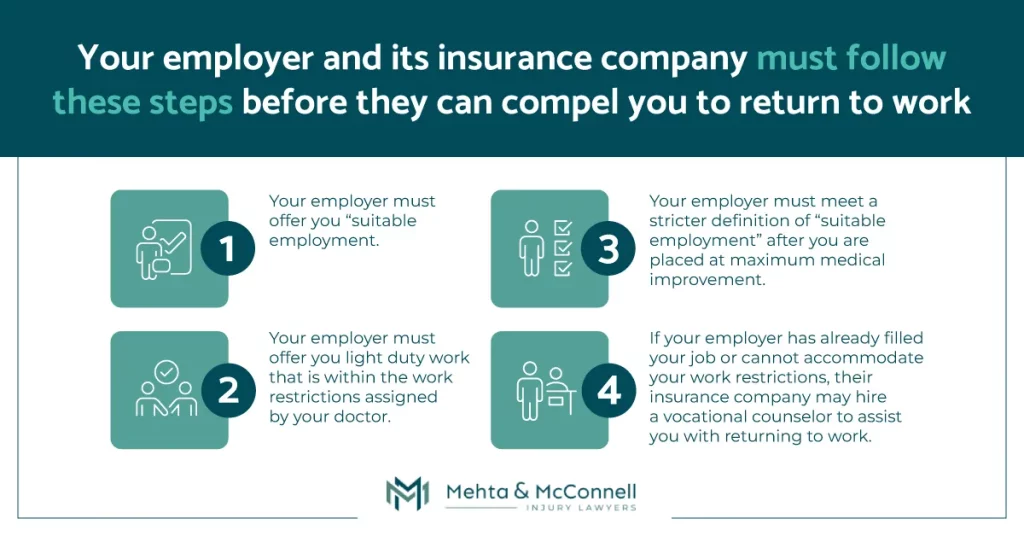
Your employer and its insurance company must follow these steps before they can compel you to return to work.
Your employer must offer you “suitable employment.” There are different definitions for “suitable employment” depending on the status of your medical treatment.
If you are still actively treating for your work injury and your doctor has not placed you at maximum medical improvement, your employer can offer you light-duty work.
Your employer must offer you light duty work that is within the work restrictions assigned by your doctor.
Under G.S. 97-32, if you refuse suitable light-duty employment without justification, your employer’s insurer can file a Form 28T with the NC Industrial Commission to suspend your wage replacement benefits. Your attorney reviews any light-duty offer before you respond to ensure the position actually meets the statutory definition of suitable employment under your current medical restrictions.
With certain jobs, your doctor may have to approve a job description before you can be forced to return to work.
After you are placed at maximum medical improvement, “suitable employment” is defined as “employment that the employee is capable of performing considering the employee’s preexisting and injury-related physical and mental limitations, vocational skills, education, and experience and is located within a 50‑mile radius of the employee’s residence at the time of injury or the employee’s current residence if the employee had a legitimate reason to relocate since the date of injury.”
No one factor will be considered exclusively in determining whether a position offered to you is “suitable employment.”
Disputes about suitable employment are resolved by the NC Industrial Commission. If your employer offers you a position you believe exceeds your medical restrictions or falls outside the 50-mile radius definition, your attorney files a Form 33 Request for Hearing with the Commission. Deputy Commissioners hold contested hearings at the NCIC’s Raleigh offices; however, many Mecklenburg County cases are settled through Commission-ordered mediation before a hearing is required.
Your employer must meet a stricter definition of “suitable employment” after you are placed at maximum medical improvement.
Why Injured Workers in Charlotte Choose Mehta & McConnell
- Representation for All Workers, Regardless of Immigration Status: North Carolina’s Workers’ Compensation Act protects every employee, and we represent injured workers across Charlotte and surrounding counties without regard to documentation status.
- Board-Certified Workers’ Comp Specialists: Viral Mehta and Jason McConnell are both board-certified by the North Carolina State Bar in workers’ compensation law, a standard met by fewer than 1% of NC attorneys.
- Former Insurance Defense Attorneys Who Know the System: Both managing attorneys spent significant portions of their careers defending employers and insurance companies. They bring that insider knowledge to every workers’ comp claim they handle for injured clients in Charlotte.
- Guidance Through Every Stage of the NC Workers’ Comp Process: From filing the initial claim to disputing denied benefits and navigating the NC Industrial Commission, our firm provides clear, reliable guidance at every step.
- Free Consultation and Contingency Fee Arrangement: There is no cost to speak with our team, and you pay no attorney fees unless we recover workers’ compensation benefits on your behalf.
If your employer has already filled your job or cannot accommodate your work restrictions, their insurance company may hire a vocational counselor to assist you with returning to work.
Once again, there are rules the vocational counselor must follow when attempting to return you to work.
We will protect your interests when returning to work is an issue in your case.
We will verify your employer and the vocational counselor have followed the law when offering you a job, and we will make sure the job offered to you is one your doctors say you can do.
Which Workers’ Compensation Benefits Could Apply to Your Injury?
North Carolina provides several benefits based on how a workplace injury affects your health and ability to earn income.
Available benefits can include:
- Medical compensation,
- Temporary total disability,
- Temporary partial disability,
- Permanent partial disability,
- Permanent and total disability, and
- Death benefits for qualifying dependents.
Temporary total disability generally provides two-thirds of an employee’s average weekly wage, subject to the applicable maximum, when a compensable condition prevents work. Temporary partial disability may apply when someone returns to work at reduced earnings. Permanent benefits address qualifying lasting impairments or disabilities.
A North Carolina workers’ compensation lawyer can determine which benefits may apply rather than focusing only on what an insurer initially offers.
Filing a Claim Requires More Than Telling Your Employer
Reporting an accident to a supervisor is important, but employees must also protect their claims through the NC Industrial Commission (NCIC). Written notice generally should be given to the employer within 30 days, while Form 18 must ordinarily be filed within 2 years.
The process generally includes:
- Report the accident. Notify your employer promptly and provide written notice.
- Get medical attention. Address emergency needs and follow authorized treatment requirements.
- Submit Form 18. File the employee’s claim with the NCIC.
- Preserve records. Keep medical notes, work restrictions, wage information, and insurance correspondence.
- Address disputes. A denial or disagreement over benefits may require further NCIC proceedings.
An employer’s Form 19 does not replace the employee’s Form 18. Other important documents include Form 28T for certain trial returns to work and Form 33 for requesting a hearing. Mehta & McConnell can handle these procedural requirements while injured employees focus on recovery.
Can a Denied Claim Still Be Challenged?
An insurer’s denial does not necessarily end a workers’ compensation case. Filing Form 33 can initiate a hearing before an NCIC Deputy Commissioner, with disputed matters generally proceeding through mediation first. Further review may be available before the Full Commission and, eventually, the North Carolina Court of Appeals.
Treatment rules also change after a denial. While employers or carriers generally direct authorized care in accepted cases, the NCIC states that workers may choose their medical provider after liability is denied.
A North Carolina workers’ comp attorney can examine the reason for rejection, gather supporting evidence, and pursue the appropriate review.
An Independent Contractor Label May Not Decide Coverage
Being called an independent contractor does not automatically make someone ineligible for workers’ compensation. The actual working relationship matters.
Classification can depend on factors such as the degree of control over the work and other circumstances surrounding the arrangement. The NCIC investigates suspected employee misclassification through its Employee Classification Section. Workers denied benefits because they were classified as independent contractors should consider having their employment relationship reviewed.
A Work Accident May Also Support a Third-Party Claim
Someone other than an employer may share responsibility for a workplace injury. Examples include an outside motorist, a negligent subcontractor, or an equipment manufacturer.
G.S. 97-10.2 allows qualifying third-party claims to be brought alongside workers’ compensation benefits. However, an employer or insurance carrier may have a statutory lien against proceeds recovered from the outside party.
Because the two matters can affect one another, they should be evaluated together. A North Carolina workers’ compensation lawyer can address the benefits case while determining whether another party may also be liable.
Who Controls Medical Treatment After a Work Injury?
Charlotte-area employees with severe trauma may initially receive care at facilities such as Atrium Health Carolinas Medical Center or Novant Health Presbyterian Medical Center.
For an accepted workers’ compensation case, the employer or insurer generally directs authorized treatment. An employee who wants different care may request approval from the NCIC.
When liability is denied, the Commission allows the worker to obtain treatment from a provider of their choice, subject to applicable requirements. Medical decisions can affect work restrictions, disability benefits, and permanent impairment ratings. Mehta & McConnell’s board-certified workers’ compensation attorneys help clients resolve treatment disputes while protecting their overall claims.
Is it Worth Getting a Workers’ Compensation Attorney in Charlotte?
You won’t pay us out of your pocket. We will represent you on a contingency fee basis, meaning we will receive a portion of the monetary benefits we recover for you.
The standard contingency fee in workers’ compensation cases is 25%.
The contingency fee model is beneficial for both the attorney and the injured worker. As previously stated, you will never pay out of your pocket for our representation.
If we don’t recover anything for you, then we don’t get paid.
The contingency fee model gives our attorneys every reason to fight as hard as we can for you. The more we recover for you, the greater our fee.
Both attorneys at Mehta & McConnell are board-certified specialists in workers’ compensation law by the North Carolina State Bar – a credential held by fewer than 100 attorneys in the state. Board certification requires demonstrated competence through peer review, a written examination, and a track record of complex workers’ compensation cases. When evaluating a workers’ comp attorney in Charlotte, board certification is the single most reliable indicator of specialization.
The insurance companies have authored studies that show that injured people who retain an attorney tend to receive significantly higher recoveries than people who handle their claim on their own.
That’s because an experienced attorney will pursue each and every type of benefit owed to you under the North Carolina Workers’ Compensation Act.
Learn more in our guide on lost wages claim.
The Client Experience
What It Is Like to Work With Mehta & McConnell
A workplace injury can put your paycheck, your treatment, and your peace of mind at risk all at once. Here is what working with our team looks like, in the words of the people who have lived it.
We take on the claims your employer says do not qualify
When a technicality is used to deny a claim, we look for the angle that gets you covered.
“Everyone said I didn’t qualify because I hadn’t punched in yet. My last call was to Mr. Mehta. He said there was an angle to cover me, and I won my case.”
Victor D., Google Review
We keep your checks coming and you informed
You should not have to fight for your weekly payments while you are also fighting to recover. We stay on top of both.
“From the very beginning, they made sure I was receiving my weekly workers’ compensation payments and continued to look out for me every step of the way until my settlement was finalized.”
E., Google Review
We carry the weight so you can heal
Appointments, paperwork, and calls from the insurer: we handle it, so you can put your energy into getting better.
“Having Viral on my team, I was able to just focus on recovery. Any problem that arose, I sent him a message and he took care of it.”
Que A., Google Review
A workplace injury can put everything on hold at once: your income, your health, your family. We cannot undo the injury, but we can carry the weight of the claim, and stay beside you until you are able to rebuild.
When Should You Hire a Workers’ Comp Attorney After a Workplace Injury in NC?
There are many twists and turns in a workers’ compensation claim.
Even if the insurance company is treating you well at the beginning of your claim, it may later try to stop your benefits.
It may deny medical treatment your doctors have recommended, or it not pay you wage loss benefits.
The insurance company may offer to settle your case, but you may worry that they are not making you a fair offer.
In Mecklenburg County, workers’ compensation claims arise frequently in the construction, warehousing, logistics, and healthcare sectors – all of which have significant employer presence in Charlotte. Construction workers on the ongoing South End and Uptown development projects, warehouse and distribution employees at facilities near I-85 and I-485, and healthcare workers at Atrium Health and Novant Health facilities all file claims with regularity. If your injury occurred in any of these industries or locations, an attorney familiar with the employers and insurers active in the Charlotte market can anticipate the specific tactics those carriers use.
Featured Case Result
What Happened: Our client, a Service Advisor at a car dealership, sustained a large bucket handle meniscus tear in her left knee when her office chair unexpectedly moved out from under her. Our client had worked for the car dealership for a few years and had developed a loyal client base. She had a high average weekly wage due to the commissions she received. Her permanent restrictions prevented her from returning to her pre-injury job. Defendants implemented aggressive vocational rehabilitation, requiring our client to meet with her vocational counselor weekly and apply to multiple jobs per week. Vocational rehabilitation was unsuccessful in finding suitable employment for our client, especially jobs that paid close to her pre-injury wages.
Result: $125,000 Settlement
Frequently Asked Questions
What is workers’ compensation in North Carolina?
Workers’ compensation is a no-fault insurance system that provides medical treatment and wage-replacement benefits to employees injured on the job.
Can undocumented workers file workers’ compensation claims in North Carolina?
Yes. North Carolina’s Workers’ Compensation Act protects all employees regardless of immigration status. If you were injured at work in Charlotte or anywhere in NC, you have the right to file a workers’ compensation claim and receive medical treatment and wage loss benefits. Your employer or their insurer cannot lawfully deny your claim based on your immigration documentation.
What benefits are available to injured workers under North Carolina workers’ compensation?
Workers’ compensation in North Carolina provides medical treatment for work-related injuries and illnesses, temporary total disability benefits equal to two-thirds of your average weekly wage if you are unable to work, temporary partial disability benefits if you return to work at a reduced wage, and permanent partial disability ratings for lasting impairments. Attorneys at Mehta & McConnell help injured workers in Charlotte access every benefit they are owed.
When should I hire a workers’ compensation attorney in Charlotte, NC?
If you have questions about how the worker’s compensation system works in North Carolina, you may want to contact a workers’ comp attorney even if your employer or their insurer tells you that your claim is accepted or that they are “taking care of it.” You should absolutely contact a workers’ comp attorney if your claim was denied, your medical treatment was refused, your disability benefits were cut off or reduced, you are being pressured to return to work before you are medically ready, or you received a settlement offer and are unsure whether it reflects the full value of your claim. Early legal guidance can prevent mistakes that are difficult to correct later in the process.
Can my employer force me back to work after an injury in Charlotte?
No. Under North Carolina’s Workers’ Compensation Act, your employer cannot compel you to return to work unless they offer you suitable employment that falls within the restrictions assigned by your treating physician. For workers who have reached maximum medical improvement, stricter standards apply. If you are being pressured to return to work in a way that violates your doctor’s restrictions, contact a Charlotte workers’ comp lawyer immediately.
How are workers’ compensation attorney fees handled in North Carolina?
Workers’ compensation attorney fees in North Carolina are contingency-based and capped at 25 percent of any recovery. They must also be approved by the NC Industrial Commission. This means you pay no upfront legal fees, and any attorney fee comes directly from your settlement or benefit award rather than out of pocket. Initial consultations at Mehta & McConnell are completely free.
What steps should I take immediately after a workplace injury in North Carolina?
Report your injury to your employer or supervisor as soon as possible, seek medical treatment right away, and keep records of all communications, medical appointments, and work notes related to your injury. Reporting promptly is important because delays can give employers and insurers grounds to dispute whether the injury is work-related. Contact a North Carolina workplace injury attorney if you are uncertain about your rights or if your employer resists your workers’ comp claim.
Does fault matter or workers’ compensation claims in North Carolina?
No. North Carolina workers’ compensation is a no-fault system. You are entitled to file a workers’ comp claim and receive benefits regardless of whether your employer, a coworker, or your own actions contributed to the workplace accident. The key requirement is that the injury occurred in the course and scope of your employment. There are limited exceptions for intentional self-harm or intoxication.
What if my employer does not have workers’ compensation insurance in Charlotte, NC?
If your employer is required to carry workers’ comp insurance and has failed to do so, you may be able to file a claim directly against your employer through the NC Industrial Commission’s Uninsured Employer Fund. You may also have the right to sue your employer in civil court in some circumstances. A Charlotte workplace injury attorney can advise you on the best path forward in this situation.
Can I be fired for filing a workers’ compensation claim in North Carolina?
It is illegal in North Carolina for an employer to retaliate against an employee for filing a workers’ compensation claim. If you believe you were terminated or otherwise treated unfairly because of your workers’ comp claim, you may have a separate legal claim for retaliatory discharge. Contact a workplace injury lawyer in Charlotte to discuss your situation and understand your options.
What is the role of the NC Industrial Commission in a workers’ comp claim?
The North Carolina Industrial Commission is the state agency that administers all workers’ compensation claims, disputes, and appeals. If your claim is disputed, you may be entitled to a hearing before a Deputy Commissioner, with the right to appeal to the Full Commission and ultimately to the NC Court of Appeals. Board-certified workers’ comp attorneys at Mehta & McConnell are experienced in representing injured workers at every level of the NC Industrial Commission process.
Who is covered by workers’ compensation in North Carolina?
North Carolina requires employers with three or more employees to carry workers’ compensation insurance. If your employer meets that threshold and you suffered a work-related injury or occupational illness, you are generally entitled to file a claim regardless of fault. Coverage applies to both full-time and many part-time workers in Charlotte and throughout NC.
What workers’ compensation benefits can I receive after a workplace injury in Charlotte?
Workers’ comp benefits in North Carolina include medical treatment for work-related injuries, temporary total disability payments equal to two-thirds of your pre-injury average weekly wage if you cannot work, temporary partial disability if you return to work at a reduced wage, and permanent partial disability ratings for lasting impairments. A board-certified Charlotte workers’ comp attorney can ensure you receive every benefit you are entitled to.
What happens if I refuse light duty work offered by my Charlotte employer after an injury?
Under North Carolina law, your employer can offer you suitable light duty work that falls within your doctor-assigned restrictions. If you refuse without good cause, the insurer can take steps to reduce or suspend your disability benefits. However, the work offered must meet specific legal requirements including matching your medical restrictions and being located within a reasonable distance of your home. In addition, any proposed job your employer offers you must first be approved by your treating physician.A workers’ comp lawyer can help you evaluate whether an offer of light duty is legally appropriate.
Can the insurance company stop my workers’ comp benefits without warning in Charlotte?
No. An insurance company cannot simply stop your workers’ compensation disability benefits without following the proper legal procedures required by the NC Industrial Commission. If your benefits have been stopped or reduced without explanation, you should contact a board-certified Charlotte workers’ comp attorney immediately to evaluate your options and protect your rights.
How much does it cost to hire a workers’ compensation attorney in Charlotte, NC?
At Mehta & McConnell, we handle workers’ compensation cases on a contingency fee basis. You pay no upfront fees, and attorney fees are capped at 25 percent of any recovery under North Carolina law. These fees must also be approved by the NC Industrial Commission. Your initial consultation is completely free and comes with no obligation.
Are workplace injuries always handled through workers’ comp, or can you sue your employer directly?
In most cases, workers’ comp is your exclusive remedy against your employer, meaning you generally can’t sue them directly for negligence. Exceptions can exist, such as when an employer intentionally caused harm or lacked required workers’ comp insurance, which is worth discussing with an attorney.
Does a workplace injury claim change if a third party, not your employer, caused the accident?
Yes. If a third party, like an equipment manufacturer, subcontractor, or another company’s driver, contributed to your injury, you may be able to bring a separate personal injury claim against that third party in addition to your workers’ comp claim.
What if your workplace injury results from a coworker’s negligence rather than unsafe conditions?
Workers’ comp generally still applies, since it’s a no-fault system that doesn’t require proving anyone was careless, including a coworker. Your own workers’ comp claim proceeds regardless of whether the injury was caused by unsafe conditions, a coworker’s mistake, or your own error.
Does it matter whether your workplace injury happened on company property or somewhere else while working?
Generally, no, as long as you were acting within the scope of your job duties at the time. An injury that happens while traveling for work, making a delivery, or performing a work task off-site can still qualify for workers’ comp, not just injuries that occur inside the building itself.
What Benefits Am I Entitled to Under North Carolina Workers’ Compensation?
Available benefits may include medical care, temporary total disability, temporary partial disability, permanent partial disability, permanent and total disability, or death benefits. Eligibility depends on the circumstances of the claim.
My Workers’ Compensation Claim Was Denied—What Are My Options in NC?
You can challenge a denial through the NC Industrial Commission. Form 33 requests a hearing before a Deputy Commissioner, with further review potentially available afterward.
Can I Be Fired for Filing a Workers’ Compensation Claim in North Carolina?
North Carolina’s Retaliatory Employment Discrimination Act prohibits certain retaliation for exercising protected workers’ compensation rights. REDA complaints generally must be filed with the NC Department of Labor within 180 days of the retaliatory action.
What Is the Difference Between a Workers’ Compensation Claim and a Third-Party Personal Injury Lawsuit in NC?
Workers’ compensation provides statutory benefits for qualifying job-related injuries without requiring proof of employer negligence. A third-party lawsuit seeks damages from an outside person or business responsible for causing the accident.
Can I Choose My Own Doctor for a Work Injury in North Carolina?
The employer or carrier generally directs authorized treatment in an accepted claim, although employees may request different care through the NCIC. After liability is denied, workers may seek treatment from a provider of their choice, subject to applicable rules.
Contact Our North Carolina Workers’ Compensation Attorneys at Mehta & McConnell
If you have questions at any step in your claim, make sure you speak with the experienced North Carolina workers’ comp lawyers at Mehta & McConnell before moving forward with your claim.
Both of our workplace injury attorneys are board-certified by the North Carolina State Bar as experts in workers’ compensation law.
We are happy to meet with you to have a no-obligation free consultation about your claim.
Our work injury law firm will explain the law as it applies to your case, and we will gladly answer any questions or concerns you may have.
Let us see if we can help you increase the value of your claim in a cost-effective and efficient way.
Our Charlotte workers’ compensation attorneys handle claims filed with the NC Industrial Commission on behalf of injured workers throughout Mecklenburg, Cabarrus, Union, Gaston, and Iredell counties.
Contact us today to schedule your free initial consultation.
Legal References Used to Inform This Page
To ensure the accuracy and clarity of this page, we referenced official legal and other resources during the content development process:
- North Carolina Industrial Commission – Form 18
- North Carolina Industrial Commission – Workers’ Compensation Forms
- North Carolina General Assembly – Chapter 97, Workers’ Compensation Act
- North Carolina General Assembly – G.S. 97-10.2
- North Carolina Industrial Commission – Employee Classification
- NC Department of Labor – Retaliatory Employment Discrimination