



 Workers' Compensation
A workers’ comp doctor is a physician authorized by your employer’s insurance carrier to evaluate and treat injuries sustained on the job. In North Carolina, the insurance company has the right to direct your medical care, which means the doctor you see is selected by – and reports to – the insurer, not you. What you say during these appointments becomes part of your official claim record and can directly affect whether your benefits are approved, reduced, or denied.
Understanding what not to say to a workers’ comp doctor can help protect your credibility, prevent unnecessary claim delays, and strengthen your chances of receiving full benefits.
At Mehta & McConnell, PLLC, we represent injured workers throughout Charlotte. With over 40 years of combined experience, our board-certified attorneys know how to guide clients through the most complex aspects of the workers’ compensation system—including what to expect when dealing with workers’ comp doctors.
You can reach our lawyers at 980-326-2270.
In this blog post, we’ll walk you through the common communication mistakes injured workers make with these doctors and what to say during your exam to aid your recovery.
Key Takeaways
- Every word you say to a workers’ comp doctor becomes part of your permanent medical record and can be used by insurers to delay, reduce, or deny your benefits.
- Downplaying your pain or saying “I’m fine” gives adjusters grounds to argue your injury is minor and not worthy of full compensation.
- Inconsistent symptom descriptions across appointments are a red flag that insurance companies actively search for to question your credibility.
- Lying or exaggerating your condition can be classified as workers’ comp fraud, leading to claim denial and potential criminal liability.
- A workers’ compensation attorney can help you prepare for your exam so you communicate symptoms accurately without accidentally harming your claim.
Why Your Words Matter in a Workers’ Comp Medical Exam
North Carolina workers’ compensation law recognizes two categories of medical evaluators: authorized treating physicians and independent medical examiners (IMEs). Authorized treating physicians manage the ongoing medical care of the claimant. Independent medical examiners do not provide medical treatment. Instead, insurance carriers retain independent medical examiners to conduct one-time evaluations. Insurance carriers use independent medical examination reports to contest work restrictions, dispute maximum medical improvement (MMI) status, and challenge permanent partial disability impairment ratings. Claimants must provide honest, specific, and consistent symptom descriptions to both categories of physicians to ensure data consistency across medical records.
Formal medical reports authored by authorized treating physicians and independent medical examiners heavily influence whether the workers’ compensation insurance carrier accepts the claim, what surgical or rehabilitation treatments are approved, and the monetary value of permanent disability benefits.
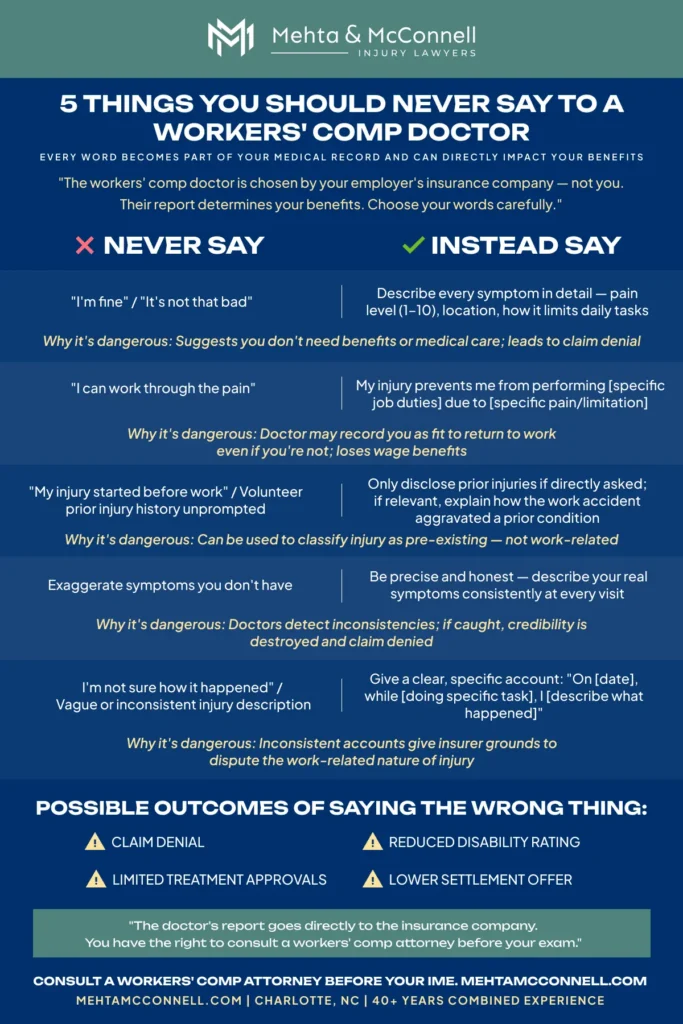
5 Things Never to Tell Your Workers’ Comp Doctor
Even small comments can have serious consequences when you’re speaking to a workers’ compensation doctor. The doctor’s report will carry weight with your employer’s insurance company, and it can influence whether you receive benefits and how much.
Read on to learn what not to say to a workers’ comp doctor.
1. “I’m not really hurt.”
Telling a workers’ comp doctor ‘I’m not really hurt’ is a critical mistake often made by employees attempting to appear stoic. Minimizing symptoms in this manner provides the insurance adjuster with medical documentation showing that the injury requires neither ongoing curative medical treatment nor wage replacement benefits. If you’re experiencing pain or limitations, be honest, not modest.
2. “It’s not that bad.”
Downplaying symptoms by stating ‘it’s not that bad’ signals to the examining physician that the impairment is superficial. Understating pain levels to a workers’ comp doctor directly results in denied authorizations for specialized diagnostic imaging (like MRIs), cancelled physical therapy regimens, and reduced disability ratings under the North Carolina Industrial Commission rating guide. Be clear about the full extent of your pain and how it affects your daily life.
3. “Everything hurts.”
It’s essential to be specific when describing your symptoms. Making diffuse, non-specific claims such as ‘everything hurts’ leads physicians to suspect symptom magnification or malingering. To preserve credibility in medical records, injured workers should describe anatomical pain points with precision, noting exact locations, pain types (dull, burning, throbbing), and specific functional triggers.
4. “I can do all my regular activities.”
When an injured employee reports being able to perform all regular activities, the workers’ compensation insurance carrier uses that clinical note to justify issuing a Form 24 application to terminate weekly wage replacement checks. An unexamined assertion of full physical capacity leads the treating physician to issue a full-duty work release without work restrictions. Be honest about what you can’t do, not just what you can.
Speculating about previous medical issues by stating ‘this might be from an old injury’ allows insurance adjusters to deny compensability by asserting the condition is entirely pre-existing. Under North Carolina law, an on-the-job aggravation or acceleration of a dormant, pre-existing condition remains 100% compensable, provided the claimant clearly distinguishes previous baselines from new, acute workplace trauma. Instead, focus on the specific changes or new symptoms that followed your workplace accident.
Just as your words matter with doctors, be aware of workers’ comp adjuster tricks designed to use your statements against you.
| Dangerous Statement | Insurer / Adjuster Interpretation | Legal / Claim Impact | Legally Sound Alternative Script |
|---|---|---|---|
| “I’m not really hurt” / “I’m fine” | Condition has resolved; employee requires no ongoing curative medical care or wage replacement. | Immediate claim denial or premature cessation of temporary total disability (TTD) checks. | “I am experiencing persistent pain in my [specific body part] that limits my ability to perform [specific job tasks].” |
| “It’s not that bad” | Pain is sub-clinical; specialized interventions (MRI, surgery, physical therapy) are medically unnecessary. | Refusal to authorize advanced diagnostics or specialist referrals under N.C.G.S. § 97-25. | “On a scale of 1 to 10, my pain is at a [number] at rest and escalates to a [number] when I attempt to lift or bend.” |
| “Everything hurts everywhere” | Symptom magnification or malingering; non-anatomical pain complaints indicate unreliable testimony. | Doctor notes credibility concerns; insurer uses negative credibility to challenge disability rating. | “My primary sharp pain originates in my lower lumbar spine and radiates down my right leg into my calf.” |
| “I can do all my regular activities” | Employee has regained full physical baseline capacity and can resume full-duty employment without restriction. | Doctor issues full-duty release; employer revokes light-duty accommodations and terminates indemnity benefits. | “I can handle basic sedentary personal care, but I cannot lift groceries, stand for over 20 minutes, or drive without spasms.” |
| “I think this is from an old injury” | Condition is solely idiopathic or degenerative, not caused or accelerated by an on-the-job accident. | Form 61 denial of compensability claiming the medical condition predates the workplace accident. | “I had prior discomfort years ago that completely resolved; this acute sharp pain began immediately after the work incident.” |
How to Deal with Workers’ Comp Doctors Strategically in North Carolina
Accurate, specific communication with a workers’ comp doctor protects your credibility and ensures your medical record reflects the true extent of your injury.
Instead of vague or risky statements, here’s what you should do:
- Be specific about your symptoms;
- Describe limitations honestly;
- Report all symptoms, even if they seem minor;
- Be consistent in your story; and
- Acknowledge pre-existing conditions, but clarify how your current injury is new or how it worsened an existing issue.
Speaking honestly helps preserve your credibility and helps the doctor document your condition accurately. If you’re ever unsure about how to communicate your injury, a workers’ comp attorney can help you prepare.
Frequently Asked Questions
Read on to learn about common questions regarding how to deal with workers’ comp doctors.
What Mistakes Do Injured Workers Make When Talking to a Workers’ Comp Doctor?
Even well-meaning employees can make costly mistakes during a workers’ comp medical evaluation. These mistakes may raise red flags for insurers or lead to a denial of benefits.
One of the most common pitfalls is providing inconsistent answers. If your description of how the injury happened or how severe your symptoms are changes from one appointment to another, doctors and insurance adjusters may question your credibility. These inconsistencies often end up in your medical records, which are key pieces of evidence in your claim.
Another major mistake is lying or exaggerating your condition. It’s natural to want your pain acknowledged, but overstating symptoms or inventing limitations can backfire. Workers’ comp doctors are trained to detect exaggeration, and surveillance footage or prior medical records can easily contradict your statements.
To protect your case, it’s essential to be honest, clear, and consistent in every interaction with your doctor. If you’re anxious about describing your symptoms accurately, a workers’ comp attorney can help you prepare.
Can Saying the Wrong Thing to a Workers’ Compensation Doctor Hurt Your Case?
Yes. Saying the wrong thing to a workers’ compensation doctor can have serious consequences. Even a minor misstatement (whether intentional or not) can be misinterpreted and used against you during the claims process.
Some of the possible outcomes include:
- Claim denial. If the doctor believes your injury is not work-related or not as serious as claimed, your benefits may be denied.
- Reduced disability rating. Inaccurate statements can lead to a lower impairment rating, which directly impacts how much compensation you receive.
- Delays in treatment. Conflicting or unclear statements might delay approval for surgery, therapy, or specialist care.
- Lower settlement value. Your credibility plays a significant role in negotiations. Inconsistencies can weaken your claim and reduce your final payout.
To protect your rights, it’s best to speak with a qualified workers’ compensation lawyer. An attorney can help you prepare for your medical evaluation, guide you through the claims process, and work for your side of the story to be accurately and effectively presented.
Can I Choose or Change My Workers’ Comp Doctor?
In most cases, you cannot pick your first workers’ comp doctor, because the employer or its insurance carrier generally directs your medical care in North Carolina. If you are unhappy with your care, you can ask the North Carolina Industrial Commission to approve a change of physician or a second opinion, but do not switch doctors on your own because you could be left with the bills. A workers’ comp attorney can help you make the request the right way.
What If My Doctor Sends Me Back to Full Duty but I’m Still Hurting?
Tell your doctor exactly what you still cannot do and ask them to write it in your chart, then talk to a workers’ comp attorney before you return to work. A full-duty release can be used to end light-duty work and ask to stop your wage replacement benefits, so it is important to challenge it early.
Talk to a Charlotte Workers’ Comp Attorney Today
Navigating a workers’ comp claim after a serious injury can be confusing, stressful, and filled with uncertainty. At Mehta & McConnell, PLLC, we help injured workers cut through the noise and focus on getting the benefits they deserve.
Our attorneys bring a results-oriented approach to every case. We’ve represented clients across a wide range of industries and understand the tactics insurance companies use to challenge claims. Whether you’ve already started the claims process or just suffered your injury, we’re here to step in, protect your rights, and guide you every step of the way.
Schedule a free consultation today to learn how we can help you protect your benefits and get back on track.

Viral Mehta
Viral Mehta is a Managing Attorney at Mehta & McConnell Injury Lawyers in Charlotte, NC, and one of fewer than 1% of North Carolina attorneys holding a North Carolina State Bar Board Certification in Workers’ Compensation law. He spent the first decade of his career defending employers and insurance companies in workers’ comp claims before switching sides to represent injured workers. A North Carolina Super Lawyer (2024, 2025) and five-time Rising Star, Viral was also a contributing author of the 2017 North Carolina Workers’ Compensation LexisNexis Practice Guide and is certified by the North Carolina Dispute Resolution Commission as a Superior Court mediator.